If you smell gas right now, leave the area and call 911 and your gas utility immediately - do not wait for a detection appointment. For planned work, when a utility or contractor suspects an underground leak and needs to know where to focus before anyone digs, Leak Finder Pros performs non-invasive above-ground profiling surveys that map suspect areas along mains and service lines. Serving Santee, CA - call (619) 939-0817 to schedule a survey.
Best for: Contractors, property managers, and utilities needing to narrow a suspected leak area. Not an emergency service.
Gas and utility leak profiling is a non-invasive above-ground survey that maps where a suspected underground leak is most likely located. Property managers and contractors in Santee use it to narrow dig areas along gas mains and utility corridors. It is planning support only - if you smell gas, leave and call 911 and your gas utility at once.
Profiling is a survey discipline, not emergency response. We walk the corridor or grid above the suspected line, taking readings at regular intervals with above-ground instruments, and build a gradient map that shows where indicators are strongest. That map tells repair crews and utilities where to concentrate their own investigation, shrinking a hundred-yard question mark down to a focused work zone. We never excavate, never touch live gas infrastructure, and never represent ourselves as a substitute for the gas utility.
In Santee this service fits planned construction and utility coordination. Contractors opening ground near Mission Gorge Road corridors, property managers dealing with aging service lines in older neighborhoods, and HOAs planning trenching work all benefit from knowing where indicators cluster before heavy equipment arrives. And the standing rule never changes: suspected active gas leaks belong to 911 and the gas utility first, always.
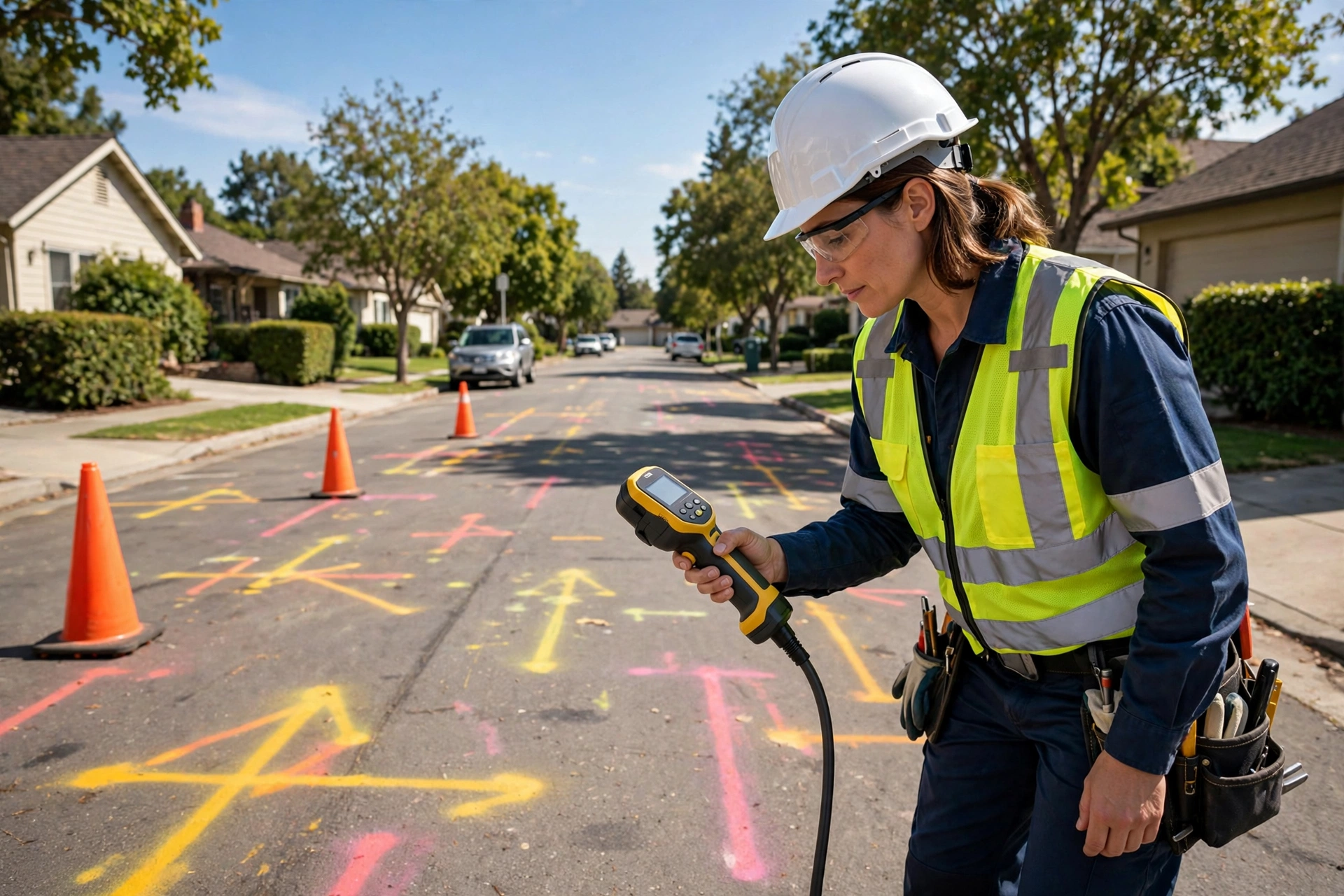
A gradient map turns a long stretch of suspected main into a focused work area, so crews open ground where the indicators actually point.
Every reading is taken at the surface. Nothing is dug, cut, or disturbed during our survey.
A documented survey map gives the gas utility a clear starting picture, which speeds up their own investigation and repair planning.
Contractors and property managers go into excavation projects knowing the suspect areas in advance instead of discovering them mid-dig.
Thorough, transparent, and built around one visit that answers everything.
We review existing utility marks, as-builts, and the reason for the survey, and confirm 811 locates are in place.
Our technician walks the full survey area to note surface conditions, access, and any immediate safety concerns.
We take systematic above-ground readings at regular intervals along the corridor or across the grid.
Readings are compiled into a map showing where indicators are strongest and how they fall off with distance.
You receive a written report with the map and prioritized zones for the utility or contractor to investigate further.
Our profiling method is borrowed from utility survey practice: systematic surface readings, disciplined grids, and honest maps. We use combustible gas indicators and bar-hole probes at the surface, electromagnetic locators to confirm line positions, and GPS to tie every reading to a real coordinate. The output is a gradient map with clear priority zones - a planning tool for professionals, not a DIY answer.

Profiling is a methodical survey discipline. We follow grids, log readings, and map results - we do not wave a wand and declare a spot.
Every engagement starts with a safety review, and we stop work immediately if conditions suggest an active hazard, directing you to 911 and the utility.
Repair crews get a readable gradient map with coordinates, not a vague verbal description, so their investigation starts ahead.
Surveys are typically completed in a single visit, with the report following quickly so your project timeline does not slip.
A profiling survey is a defined, documented engagement for planned utility work. Each visit includes:
Complete above-ground coverage of the defined survey area with systematic readings.
Electromagnetic locating to verify line positions beneath the survey grid.
A GPS-tied map showing indicator strength across the area with priority zones marked.
Findings, methods, and recommended next steps for the utility or excavation contractor.
When a leak is suspected along a long main, crews face tearing up the whole street on a guess, multiplying cost, time, and disruption.
Our gradient map narrows the suspect area to focused zones, so the utility's investigation starts where indicators are strongest.
Excavating blind near gas and utility corridors risks line strikes, which endanger crews and trigger major liability.
A pre-work profiling survey maps indicator areas in advance, giving the project team one more layer of awareness before digging.
Strips of dying vegetation along a corridor can indicate a below-ground leak affecting roots, but the source could be anywhere along the line.
We survey the corridor and map where surface indicators cluster, focusing any follow-up investigation on the right section.
A handheld instrument that detects combustible gas concentrations during above-ground survey walks.
A slender surface probe that samples soil gas at shallow depth without excavation.
Confirms the position of buried metallic lines so survey grids align with the actual corridor.
Ties every reading to precise coordinates for an accurate gradient map.
An open-path instrument that detects methane remotely during corridor walks.
Records surface conditions and reading points so the survey is fully traceable.
Santee's growth means constant interaction between construction and buried utilities, from Mission Gorge Road corridor work to trenching in established neighborhoods with aging service lines. Local contractors know that San Diego Gas & Electric infrastructure runs throughout the area, and that calling 811 before digging is the law. Our profiling surveys add a planning layer on top of standard locates: where locates show where lines are, profiling shows where indicators cluster.
California law requires utility locates before excavation. Our survey complements 811 marks; it never replaces them.
Only the gas utility handles gas infrastructure repairs and emergencies. Our role is strictly survey and mapping support for planned work.
Have questions? We have answers.
No. We provide planned profiling surveys only. If you smell gas or suspect an active leak, leave the area immediately and call 911 and your gas utility. Do not wait for a survey appointment - emergency response is the utility's job, not ours.
No. We do not excavate, cut, or repair any gas infrastructure. Our work is strictly non-invasive above-ground surveying and mapping. All repairs and emergency response belong to the gas utility and their qualified contractors. If you ever smell gas, treat it as an emergency and call 911 first.
We take systematic above-ground readings across a defined corridor or grid, then compile them into a gradient map showing where indicators are strongest. It narrows where a suspected leak is most likely located so utilities and contractors can focus their investigation.
Property managers, general contractors planning excavation, HOAs doing underground work, and utilities wanting a documented starting picture. It is a planning tool for professionals coordinating around buried infrastructure. Anyone responsible for a site where a suspected underground leak needs narrowing before investigation begins.
Most survey areas are completed in a single site visit of a few hours, depending on corridor length and grid density. The gradient map and written report follow shortly after, so your project or investigation keeps moving. Larger corridors may span two visits, scheduled back to back.
Leak Finder Pros is a leak detection company based at 8340 Magnolia Ave g, Riverside, CA 92504, serving Santee, CA β including Carlton Hills, Sky Ranch, Town Center, and surrounding neighborhoods. We specialize in non-invasive leak detection using acoustic listening, thermal imaging, and tracer gas. Call (619) 939-0817.
Don't wait until a small leak becomes a big repair. Call now and get a precise, documented answer.