Hydronic radiant floors circulate warm water through tubing buried in your floor — and when a loop leaks, pressure drops and rooms go cold. In Santee, CA, we isolate each loop and pinpoint the failure with thermal imaging and acoustic listening, all without tearing up flooring. Call (619) 939-0817 and get your even heat back.
Best for: Santee homeowners with hydronic radiant floors losing pressure or heating unevenly.
Underfloor heating leaks happen when a hydronic radiant loop loses water and pressure drops. You need detection if your boiler needs frequent refilling, some floor zones feel cold, or you spot damp patches. In Santee homes, we isolate each loop and use thermal imaging plus acoustic listening to find the failed joint without removing flooring.
Hydronic underfloor heating circulates warm water through loops of tubing embedded in the floor. When a loop develops a leak — usually at a fitting, a kinked bend, or a spot damaged during installation — system pressure drops and the boiler or heat source works harder to compensate. Because the tubing is buried, you cannot see the failure. Detection means isolating each loop, pressure-testing them one by one to find which loop loses pressure, then pinpointing the exact point along that loop with thermal imaging and acoustic listening.
Radiant floor heating is less common in Santee than in colder climates, but it appears in custom homes and remodels across neighborhoods like Lake Country, Canyon Park, and Treviso, where owners chose it for comfort. San Diego County's hard water leaves mineral scale inside hydronic loops, stressing fittings over time. And because local installers see fewer radiant systems, small installation flaws — a kinked tube, an overtightened fitting — can go unnoticed for years until pressure loss reveals them.
Tile, hardwood, and polished concrete cost far more than the tubing beneath them. We find the leak's exact point so only a small section of floor is opened.
A leaking loop loses pressure and heats unevenly, leaving cold zones. Pinpointing the failure brings every zone back to full warmth.
Constant refilling introduces fresh oxygen and minerals that corrode boilers and manifolds. Stopping the leak protects the whole system.
Without detection, the only option is opening floors loop by loop. We identify the single failed loop and the exact spot first.
Thorough, transparent, and built around one visit that answers everything.
We review your manifold layout and check overall system pressure to confirm the system is losing water.
Each heating loop is valved off and pressure-tested individually to identify exactly which loop is leaking.
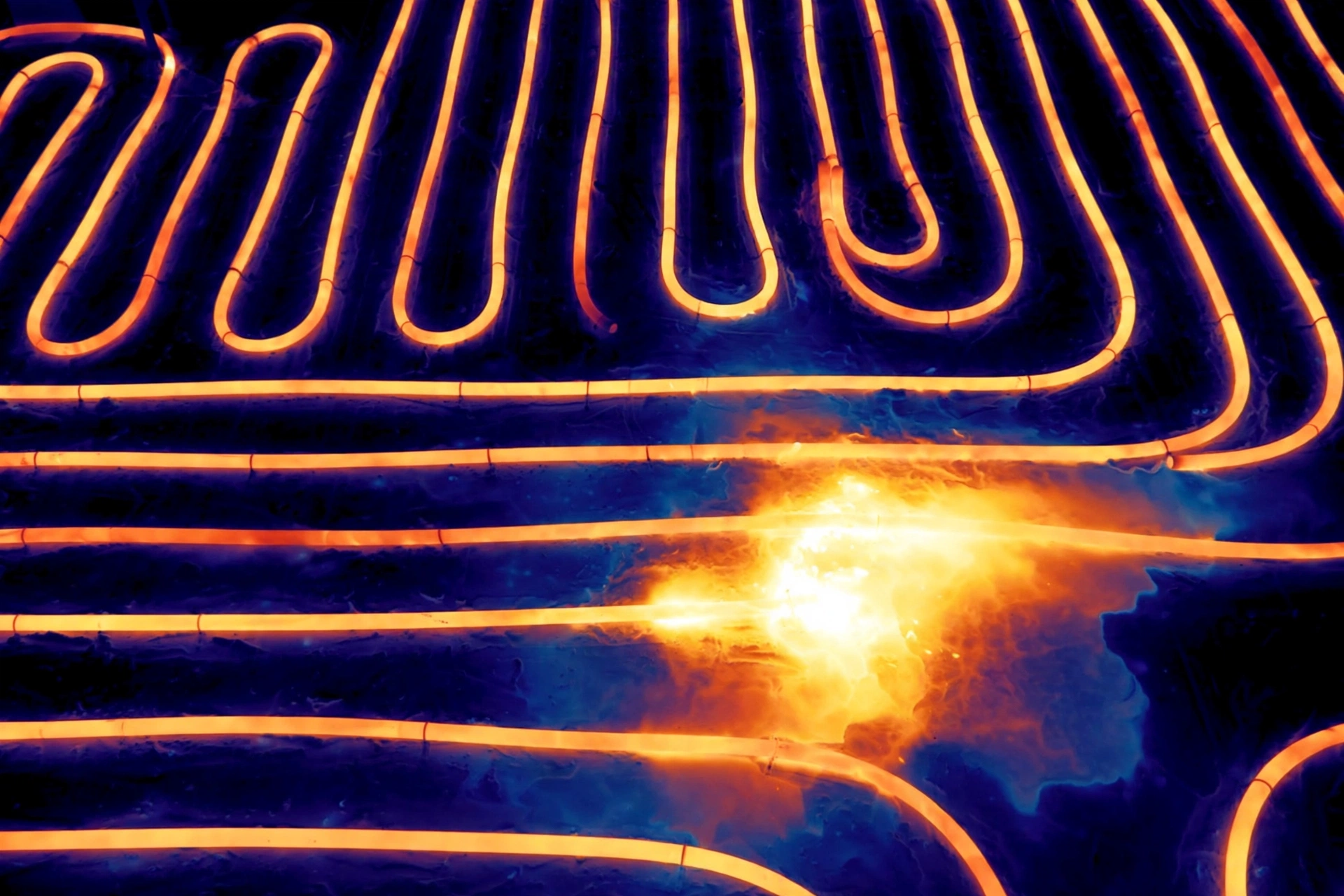
With the loop warm, an infrared camera traces its path through the floor, revealing anomalies at the leak point.
Listening equipment picks up the sound of water escaping at the suspect point, confirming the location before marking.
We mark the leak location and document which loop failed and our test results for your heating contractor.
Radiant systems demand a different playbook from standard plumbing. Our technicians understand manifold layouts, loop balancing, and how hydronic pressure behaves, so we test the system the way it was designed to be tested. Thermal imaging does the heavy lifting on warm loops, and acoustic listening confirms — two independent methods agreeing on one spot.

Most leak companies rarely see hydronic floors. We understand loop layouts and manifold logic, so testing is methodical instead of trial and error.
Your flooring is the most expensive part of the system. Every method we use is chosen to minimize the area that must be opened.
We only detect. Your heating contractor gets an exact location and test data — there is no incentive to exaggerate the problem.
While isolating loops, we note pressure behavior across the system, flagging other weak loops before they fail.
An underfloor heating detection visit is a full diagnostic of your hydronic system. We determine whether you are losing water, which loop is responsible, and exactly where along that loop the failure sits.
We verify the system is losing water and measure the rate of pressure loss.
Every loop is isolated and tested so the leaking circuit is identified with certainty.
Infrared imaging and listening equipment converge on the exact failure point.
You receive the failed loop's identity, the marked location, and test results for your contractor.
A leaking loop cannot hold pressure, so it heats unevenly or not at all — and the problem spreads as pressure drops system-wide.
We identify the failed loop and mark the leak point, so the repair restores full, even heating.
Topping up the system introduces oxygen-rich fresh water that corrodes the boiler, pump, and manifold from the inside.
Finding and fixing the leak stops the refill cycle and protects every metal component in the system.
Even a slow loop leak soaks subflooring and adhesives over time, loosening tile and warping wood floors.
Pinpointing the leak early limits the wet area to one spot instead of a spreading zone of damage.
Traces warm tubing paths through the floor and reveals anomalies where a loop is leaking.
Isolates and pressurizes individual heating loops to identify which circuit loses pressure.
Picks up the subtle sound of water escaping from low-pressure hydronic tubing.
Monitor system and loop pressures to measure the rate of water loss.
Checks flooring and subfloor around the suspect area for hidden dampness.
Introduces a safe detectable gas into the failed loop to confirm the exact leak point.
Radiant floor heating is a premium choice in Santee, found mostly in custom builds and high-end remodels in Lake Country, Canyon Park, and Treviso. Because these systems are uncommon locally, many general plumbers have limited experience diagnosing them — which is exactly when a detection specialist earns their keep. San Diego County's hard water also leaves scale in hydronic loops over the years, adding stress to fittings and joints that were flawless on installation day.
Mineral buildup from hard local water stresses fittings and narrows tubing, raising the odds of loop failures over time.
Few Santee contractors specialize in hydronic floors, so accurate detection prevents misdiagnosis and unnecessary floor demolition.
Have questions? We have answers.
Most detection visits fall in the $200–$500 range, depending on how many loops your system has. Each loop must be isolated and tested individually. Call (619) 939-0817 and we will explain the process for your specific manifold setup before we arrive.
Our detection itself never damages flooring — we locate the leak with thermal imaging and listening equipment, then mark the spot. The actual repair will need a small opening at that marked point, done by your heating contractor. Without detection, far more floor would be opened searching blindly.
Hydronic systems should not need frequent refilling — a sealed system holds pressure for months. If you are topping up every few weeks or the gauge drops steadily, water is escaping somewhere. Our loop-by-loop test proves which circuit is losing water and rules out boiler or expansion tank issues.
Yes. Thermal imaging sees heat patterns through tile, stone, hardwood, and polished concrete, and acoustic sensors work through any flooring type. The tubing's warmth makes it visible to infrared even when it is completely hidden, which is why this method suits radiant floors so well.
Most failures happen at fittings, at kinked bends stressed during installation, or where tubing was nicked by a fastener. Hard water scale adds stress over the years. Our testing identifies not just the location but the pattern, so your contractor can see whether it is a single bad joint or a wider issue.
Leak Finder Pros is a leak detection company based at 8340 Magnolia Ave g, Riverside, CA 92504, serving Santee, CA — including Carlton Hills, Sky Ranch, Town Center, and surrounding neighborhoods. We specialize in non-invasive leak detection using acoustic listening, thermal imaging, and tracer gas. Call (619) 939-0817.
Don't wait until a small leak becomes a big repair. Call now and get a precise, documented answer.