The main water line runs buried from your meter to your house, and when it breaks, the signs show up in your yard and on your bill. In Santee, CA, we trace the line's underground path and listen for the leak along its route — marking the exact spot so repairs need one small dig, not a trench. Call (619) 939-0817 before a soggy patch becomes a sinkhole.
Best for: Santee homeowners with soggy yard patches, low water pressure, or high bills and no visible leak.
A main water line leak is a break in the buried pipe from your meter to your house. You need detection for soggy yard patches, low water pressure, or a high bill with no visible cause. Our Santee team traces the line and pinpoints the leak underground, so repairs need only one small dig.
The main water line is the buried pipe carrying water from the meter at the street to your house — usually the largest pipe on your property and always under pressure. Leaks start at corroded sections, failed joints, or spots where roots or ground movement cracked the pipe. Because the line is buried two feet or more underground, the only evidence is often indirect: a soggy patch, a hissing sound, or a bill that makes no sense. Detection traces the line's underground path with a pipe locator, then uses acoustic equipment to listen for the leak along its route.
Santee's older neighborhoods still rely on original service lines installed decades ago — galvanized steel in the oldest homes around West Santee and Town Center, aging copper elsewhere. Local clay soils shift with every wet-dry cycle, flexing rigid pipes until they crack. Mature landscaping adds root intrusion, and San Diego County's hard water corrodes metal lines from within. With water rates among the highest in the region, a main line leak can add hundreds of dollars to a bill before anyone notices damp soil.
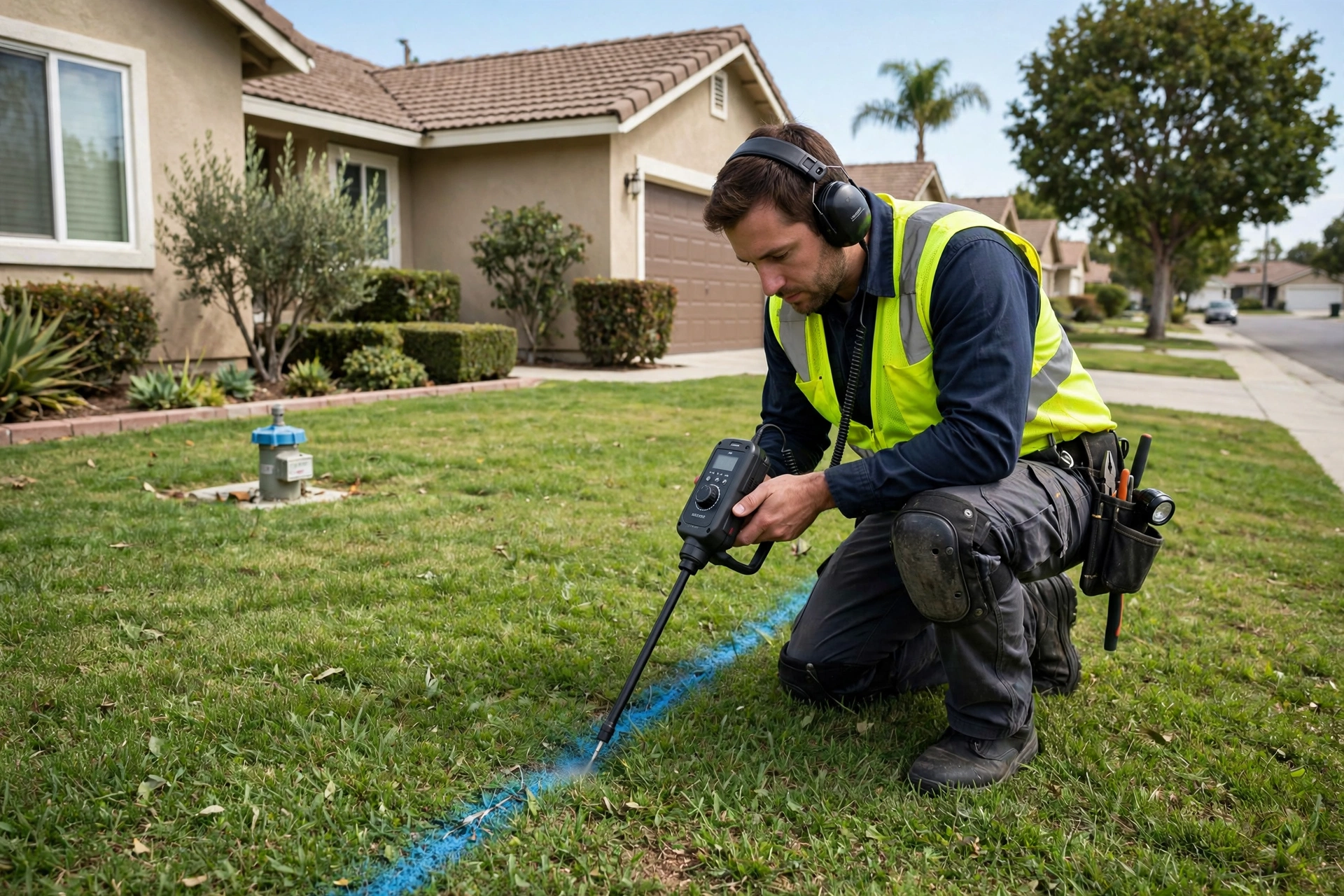
We mark the leak's location along the buried line, so your plumber excavates a single targeted hole instead of trenching the whole yard.
Tracing the line first means trees, lawns, and hardscaping stay intact — no exploratory digging across the property.
A main line leak runs constantly at full pressure. Finding it quickly can save thousands of gallons every month.
Our findings help you show the water utility exactly when and where the leak occurred, which can support a bill adjustment request.
Thorough, transparent, and built around one visit that answers everything.
We shut off the house valve and watch the meter — movement proves the leak is in the buried line, not inside the home.
A pipe locator traces the service line's exact underground route from the meter to the house.
We listen at intervals along the traced path for the distinctive sound of water escaping under pressure.
Ground microphones narrow the sound to its loudest point, marking the leak's position on the surface above.
We flag the spot and provide a written summary with the line's path and our findings for your plumber.
Buried line work is about patience and method. Our technicians trace first and listen second — never the other way around — because listening in the wrong place finds nothing. We account for soil conditions, pipe material, and depth, adjusting our acoustic approach until the leak's signature stands out clearly from background noise.

Exploratory trenching destroys yards and still might miss. Our traced, marked location means the first shovel hits the right spot.
We do not sell line replacements, so our marked location is honest — sized to the actual leak, not to a bigger job.
You do not just get a leak point; you learn your service line's entire path, which helps with all future yard work.
Santee yards are an investment. Our non-invasive process keeps lawns, trees, and patios untouched during diagnosis.
A main water line detection visit confirms the leak is in the buried service line, maps the line's underground path, and pinpoints the failure — everything needed for a single, targeted excavation.
Meter testing with the house valve closed proves the leak is underground, not inside the home.
We map the service line's exact route from the meter to the house entry.
Listening equipment scans the traced route for the sound of escaping water.
The leak point is flagged on the surface with a written summary for your plumber.
A pressurized leak washes soil away underground, creating voids that can collapse into sinkholes or undermine walkways and driveways.
We pinpoint the break so the line is fixed before voids grow into structural problems.
Water migrating toward the house can saturate the soil against the foundation or lift concrete patios and walkways.
Early detection stops the water's path before it reaches structures.
The main line carries full street pressure, so even a moderate break wastes a shocking volume of water around the clock.
Our meter test quantifies the loss, and a pinpointed repair ends it — with documentation that may help with a bill adjustment.
Sends a signal through the buried line and traces its exact underground path to the surface.
Listens through soil for the pressurized hiss of water escaping from the buried pipe.
Measures water movement at the meter to confirm and quantify an underground leak.
A slim probe that checks soil saturation at depth to verify the leak's position.
Test line pressure to assess the severity of the break.
Mark the traced line path and leak point clearly on the surface for the repair crew.
In Santee, main water line failures follow the age of the neighborhood. West Santee and the older streets near Town Center still have original galvanized service lines that corrode from the inside out. Newer areas like Sky Ranch and Weston have modern materials but sit on the same shifting clay soils that flex every buried pipe. Mature trees across Carlton Oaks and Riverwalk send roots hunting for moisture — and a slightly damp pipe joint is exactly what they find. Whatever the cause, the fix starts with knowing precisely where to dig.
Seasonal swelling and shrinking of Santee's clay ground stresses rigid service lines until joints fail or pipes crack.
Established landscaping across Santee sends roots toward buried lines, where they exploit tiny joint gaps and widen them into leaks.
Have questions? We have answers.
Most detection visits fall in the $200–$500 range, depending on the line's length and how deep it is buried. That covers tracing, acoustic pinpointing, and the marked location — excavation and repair are separate. Call (619) 939-0817 for a clear explanation of what is included.
We close the house shutoff valve and watch the meter. If the meter still moves, water is escaping in the buried line between the meter and the house. If it stops, the leak is inside. This simple test answers the question definitively in minutes.
No. Tracing and acoustic listening are completely non-invasive — we walk the yard with equipment and mark the surface. Digging happens later, done by your plumber, and only at the single marked spot. That is the whole point of detection: one small hole instead of a trench.
Yes, if the break is near the house. Escaping water saturates the soil against the foundation and can erode support or seep toward the slab. In Santee's expansive soils, added moisture also increases soil movement. Finding the leak early keeps a yard problem from becoming a foundation problem.
Age and corrosion lead the list — older galvanized and copper lines simply wear out. Shifting clay soil flexes rigid pipes, tree roots invade joints, and hard water corrodes from within. Our tracing and testing identify the failure point regardless of which cause is responsible.
Leak Finder Pros is a leak detection company based at 8340 Magnolia Ave g, Riverside, CA 92504, serving Santee, CA — including Carlton Hills, Sky Ranch, Town Center, and surrounding neighborhoods. We specialize in non-invasive leak detection using acoustic listening, thermal imaging, and tracer gas. Call (619) 939-0817.
Don't wait until a small leak becomes a big repair. Call now and get a precise, documented answer.